This auto review page contains features and specifications (specs) of Suzuki Kizashi 3 Concept along with its video and hi-res photos.
Photo: Suzuki Kizashi 3 Concept at 2008 New York Auto Show ---------------- ----------------
The Kizashi concept series was developed by Suzuki’s Advanced Design Group to reflect a dynamic athlete in motion, taking its design cues from a strong, honed physique while displaying the performance, strength and style befitting a flagship vehicle.
Video: Suzuki Kizashi 3 Concept Animated Video
---------------- ----------------
2008 New York Auto Show: Suzuki Concept Kizashi 3 The show car looks quite large, but the Kizashi 3 is technically a midsize sedan. The deep grille looks like yet another copy of Audi's new design direction, complete with a chrome cross-member. The car's a bit snub-nosed, similar to the Toyota Camry with which it would compete. The 21-inch wheels and tiny side mirrors are auto-show-only, but Suzuki says the concept is 90-95% of what the real product will look like — bold stuff. The interior is a mystery, because the concept's isn't representative and wasn't on display.
The car is powered by GM's relatively new 3.6-liter direct-injection V-6, which also appears in the Cadillac CTS and Chevrolet Malibu, to name two models. It produces 300 hp here. The transmission is a six-speed automatic with paddle shifting. source:Kicking Tires
---------------- ----------------
Photo: Suzuki Kizashi 3 Concept, Back View ---------------- ----------------
New York 2008: Suzuki unveils Kizashi 3 concept, coming in 2010 Sporting a toned-down version of the gaping maw found on the first two concepts, deeply drawn headlights and recessed fog lamps, the fascia has made the successful transition from design exercise to down-to-earth concept. While the profile and rear end is a little less dramatic than the view up front, the 21-inch wheels add a healthy amount of visual weight down below. Underneath the hood is a 300-hp, 3.6-liter V6 that drives all four wheels through Suzuki's intelligent AWD system.
Suzuki made it very clear that the Kizashi 3 is a close representation of the production model that will arrive in the U.S. by 2010. source:Autoblog
---------------- ----------------
Photo: Suzuki Kizashi 3 Concept, Front View ---------------- ----------------
Suzuki Concept Kizashi 3 American Suzuki Motor Corp. unveil Concept Kizashi 3. In addition to the North American reveals of Concept Kizashi and Concept Kizashi 2, the global introduction of Concept Kizashi 3 coincides with Suzuki’s announcement that it will produce a sport sedan derived from the Concept Kizashi 3 design. "Kizashi means ‘prelude’ in Japanese, and that’s exactly what this design represents for Suzuki from both a business and a product standpoint",said Mark Harano, president, American Suzuki Automotive Operations.
The future production model will be built at Suzuki’s brand-new Sagara plant in Japan, currently under construction, and provide an accessible alternative to the near-luxury segment. While a firm timetable has not been announced, Suzuki will deliver the Kizashi-influenced sport sedan to North American dealers by 2010. source:Just Elite Cars
---------------- ----------------
Video: SUZUKI DEBUTS CONCEPT KIZASHI 3 AT 2008 NEW YORK INTERNATIONAL AUTO SHOW
---------------- ----------------
Suzuki premiers Kizashi 3 concept The Kizashi 3 concept features a muscular, planted stance, a short front overhang and 21 inch wheels. A large front grill, shared with the other Kizashi concept cars, clearly signals Suzuki's new design direction. Overall, the Kizashi 3 looks like the car the Hyundai Genesis Sedan should have been.
Suzuki has already announced that it will produce three variants of the Kizashi — a wagon, CUV and sedan. The Kizashi and Kizashi 2 showcased the wagon and CUV body styles, respectively, so look for the newest concept to preview the sedan's design. source:Left Lane
Suzuki "Way of Life!" brand spirit illustrated by world debut of athletic Concept Kizashi 3 Suzuki broadcasts plan to produce global sport sedan based on Concept Kizashi 3 design Series premiere of complete Concept Kizashi family NEW YORK (March 20, 2008) – Performing onstage at this year's New York International Auto Show in front of a packed house, American Suzuki Motor Corp. hosts the world debut of its sleek and athletic Concept Kizashi 3, which completes the company's star-studded cast of media-acclaimed Kizashi concepts. In addition to the North American reveals of Concept Kizashi and Concept Kizashi 2, the global introduction of Concept Kizashi 3 coincides with Suzuki's announcement that it will produce a sport sedan derived from the Concept Kizashi 3 design.
The Concept Kizashi series was developed by Suzuki's Advanced Design Group to reflect a dynamic athlete in motion, taking design cues from a strong, honed physique while displaying the performance, strength and style befitting a flagship vehicle. The design theme began with Concept Kizashi, which made its debut at the 2007 International Motor Show in Frankfurt, and the Concept Kizashi 2, unveiled at the 2007 Tokyo Motor Show, which further revealed Suzuki's new design language.
"Kizashi means 'prelude' in Japanese, and that's exactly what this design represents for Suzuki from both a business and a product standpoint," said Mark Harano, president, American Suzuki Automotive Operations. "Concept Kizashi 3 illustrates our brand character and personifies our heritage, design strength and engineering prowess. With customers in 192 countries and regions, Suzuki is truly a global brand, and the coming model carries on our mission to build the image of our automotive products in North America and eventually match our bikes' reputation."
Known primarily as a maker of small vehicles, Suzuki intends for the production derivative of the Kizashi series to serve as the company's flagship vehicle, strengthening its current product line of small cars, trucks and SUVs with a sporting, more accommodating sedan. The future production model will be built at Suzuki's brand-new Sagara plant in Japan, currently under construction, and provide an accessible alternative to the near-luxury segment. While a firm timetable has not been announced, Suzuki will deliver the Kizashi-influenced sport sedan to North American dealers by 2010.
The Concept Kizashi Series Evoking the physical superiority and dignity of a world-class athlete, the Concept Kizashi series was developed to create a substantial presence that redefines the traditional performance vehicle and moves the Suzuki brand upscale. The overall design theme suggests physical strength from intense daily training, with the strong will, commitment and presence of a champion.
Each of the Concept Kizashi vehicles strikes a balance between driver comfort and sportiness, with roomy cabins melded to lean, dynamic exteriors. The hood and body style of all three Concept Kizashis hint at abundant engine power and wind-splitting aerodynamics, while the long wheelbase, aggressive wheel/tire combinations and abbreviated overhangs communicate a performance-oriented, energetic image. A powerful-looking body profile is incorporated throughout the series to convey underlying strength, with large wheels and a wide tread expressing a capacity for superior performance. Beyond its exterior architecture, the Concept Kizashi series constitutes a four-wheeled continuation of Suzuki's exciting, performance-oriented motorcycle heritage, represented best by its dynamic, world-renowned line of GSX-R sportbikes. Those bikes, some two decades after their introduction, continue to dominate the sportbike segment and have achieved iconic status.
Concept Kizashi Concept Kizashi made its world debut at the 2007 International Motor Show in Frankfurt, demonstrating Suzuki's progress toward the development of a vehicle that combines sportiness, style and substance. As the first concept in the Kizashi series, the vehicle's dynamic exterior was specifically developed to push the envelope and establish the overall design theme of the series. Reflecting the spirit of a highway athlete, the exaggerated dimensions of Concept Kizashi and its strong fascia communicate a dignified character and the overall presence of a dynamic flagship vehicle.
Video: Suzuki Auto Concept Kizashi, Animated Video
Concept Kizashi 2 Debuted at the 2007 Tokyo Motor Show, the Concept Kizashi 2 crossover sport wagon aims at drivers with dynamic lifestyles and can accommodate a wide range of activities. Continuing the series' athletic theme, Concept Kizashi 2 reflects the body of a triathlete, with the five-door vehicle's all-road capability enhanced by its raised height and all-wheel-drive configuration. In addition to the sport crossover's versatility, its 3.6 liter V6 engine and six-speed automatic transmission promise a rewarding and engaging driving experience for daily drivers and enthusiasts alike.
Video: Suzuki Concept Kizashi 2 at Tokyo Motor Show 2007
Concept Kizashi 3 The closest-to-production variation of the Concept Kizashi series, Concept Kizashi 3 embodies Suzuki's interpretation of the sport sedan segment in the North American market. The Kizashi's "super sport" identity, a core component of the Suzuki brand DNA, is tempered by the vehicle's overall mission to provide strong, refined urban performance.
As with Concept Kizashi and Concept Kizashi 2, the front end of the Concept Kizashi 3 expresses strength and style, with sharply fashioned headlights that emphasize the sensation of forward motion. The vehicle's exquisitely engineered body reflects Suzuki's distinctive combination of capability and refinement, with power flowing from a 3.6-liter DOHC V6 engine with plated cylinders – a weight-and space-saving technology that evolved from the lessons learned by Suzuki's motorcycle and WRC development teams. The body's monochrome finish, Kizashi Silver, gives the vehicle a sense of composure and depth of character, with metallic paint sparkling to emphasize the dynamism of the body's cross-section.
Concept Kizashi 3 Specifications Powertrain layout: Front engine, four-wheel drive with Advanced i-AWD system Seating capacity (persons): Five Tires: 255/30ZR21 9.5J Wheels: 21-inch, nine-spoke, aluminum Engine: 3,564cm3 V6, DOHC, 24-valve Transmission: Six-speed automatic (with paddle shifters) Maximum power: 300 hp Overall length: 4,650mm/183.1 in. Overall width: 1,900mm/74.8 in. Overall height: 1,450mm/57.1 in. Wheelbase: 2,800mm/110.2 in. Minimum ground clearance: 120mm Body color: Kizashi Silver
Read more >>
This auto review page contains interior & exterior features and specifications (specs) of the latest 2009-2010 US (America) model Hyundai Genesis RWD Sports Coupe along with its videos and high resolution photos
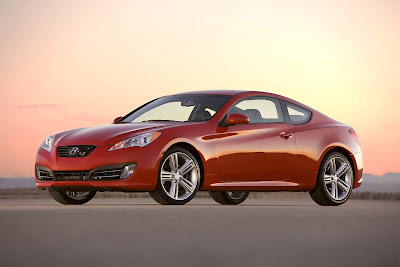
Introducing 2010 Hyundai Genesis RWD Sports Coupe On March 20th, the Genesis Coupe officially debuted at the 2008 New York International Auto Show. The Hyundai Genesis Coupe, is the production version of the Concept Genesis Coupe. It is Hyundai's newest RWD (rear-wheel-drive) car. This coupe is scheduled to hit dealerships early 2009. It was designed in Hyundai's California based design studio in Orange County, California. The Coupe initially debuted in concept form at the 2007 Los Angeles International Auto Show after much anticipation from the tuner crowd and Hyundai faithful.
This coupe should not be confused with the new Hyundai Genesis Sedan unveiled in the 2007 New York International Auto Show, although the two cars will share the same basic platform. The 2 + 2 coupe will be Hyundai's 2nd recent rear-drive vehicle released, and Hyundai's first 300+ horse power sports car. source:Wikipedia
---------------- ----------------
Photo : 2010 Hyundai Genesis RWD Sports Coupe being unveiled at 2008 New York International Auto (Motor) Show Click for photo gallery ---------------- ----------------
2010 Hyundai Genesis RWD Coupe Specifications(specs) & Features
Debut(unveiled) at: 2008 New York International Auto Show on 20 March 2008
Available(launch) by: Spring of 2009 as a 2010 model
Configuration: Front engine and rear wheel drive (RWD) sports car
Engine 1: All-aluminum DOHC 2.0L turbocharged 4 cylinder with continuously variable valve timing on both the intake and exhaust produce 212-hp horsepower (223-hp on premium fuel) and 217 pound-feet of torque with curb weight of 3,439-lb
Engine 2: All-aluminum DOHC 3.8L V6 with variable valve timing on the intake side produce 306-hp horsepower and 263 pound-feet of torque at 4,700 RPM with curb weight of 3,518-lb
Transmission: six-speed manual (for both models), five-speed auto for the 4-cylinder model and a ZF six-speed slushbox for the V6
Suspension: MacPherson strut dual-link front suspension and a five-link rear suspension
Est. Price: base model turbo-I4 estimate price is $19,900 and its V6 model starting at $25,900
Key Features: HID Xenon headlamps with auto-levelling, Smart key with push-button start, large speedo and tachometer front and center, multi-function steering wheel, an information display atop the dashboard, an Infinity audio system with iPod connectivity, XM Satellite Radio and Bluetooth will be standard. .
Three Trim Level Options: The Genesis Coupe is offered in three trim levels: the stylish and affordable GS, the premium-sport GT featuring the 3.8-liter V6, and the high-performance SE, available with either the 2.0-liter turbocharged four-cylinder engine or the 3.8-liter V6 engine.
---------------- ----------------
Test Drive Video : 2010 Hyundai Genesis RWD Sports Coupe is being test driven on desert roads and its interiors & exteriors are being explored.
---------------- ----------------
Quotes John Krafcik, vice president, product development and strategic planning, Hyundai Motor America said: "We think our entry-level Genesis Coupe 2.0t, with its unique combination of rear-wheel drive and four-cylinder turbo power, offers an intriguing alternative to existing front-wheel drive sport coupes" "The 3.8-liter version of Genesis Coupe takes driving to an even higher level, rivaling the capability of premium-performance coupes like the Infiniti G37."
Joel Piaskowski, chief designer at the Hyundai Design Center in Irvine, Calif said: "The mission for Genesis Coupe was to create a pure performance car with a design that would capture the imagination of hardcore automotive enthusiasts" "With its aggressive look from just about any angle, I think we have been able to do that." ---------------- ----------------
Photo : 2010 Hyundai Genesis RWD Sports Coupe ---------------- ----------------
New York 2008: Hyundai Genesis Coupe debuts! On the one hand, Hyundai is offering enthusiasts the only rear-wheel-drive coupe on the market powered by a turbocharged four-cylinder (not all of us want our hair ruffled in RWD four-cylinder convertibles like the Mazda MX-5, GM's Kappa convertibles and the Honda S2000). While on the other, it's also debuting a RWD coupe powered by a 306-horsepower 3.8L V6 (310 hp when drinking premium) that should undercut all similarly powered competition by thousands of dollars. The Genesis Coupe is a win-win car no matter which engine you choose. source:Autoblog ---------------- ----------------
Photo : Front-Side View of 2010 Hyundai Genesis RWD Sports Coupe ---------------- ----------------
2010 Hyundai Genesis Coupe specs The front seatbelts have pretensioners and force limiters, and the rear seats feature LATCH (Lower Anchors and Tethers for Children), which make affixing child safety seats easier.
GENESIS COUPE GS (Preliminary packaging subject to change)
Key Standard Equipment:
2.0-liter turbocharged, intercooled four-cylinder engine Electronic Stability Control Traction Control System ABS Tire Pressure Monitoring System Front, side, side air curtain air bags Active front head restraints Manual A/C Keyless entry Power windows, door locks, and mirrors AM/FM/XM/CD Player/USB/iPod connectivity Steering wheel audio controls Cruise control Vanity mirror illumination Bluetooth
GENESIS COUPE GT (Preliminary packaging subject to change) GS equipment Plus:
3.8-liter DOHC V6 Leather steering wheel / Shift knob Metalgrain /chrome interior accents Automatic temperature control Fog lamps Premium door sill plates Trip computer Chrome front fascia accents Auto light control
GENESIS COUPE SE (Preliminary packaging subject to change) Unique SE equipment:
2.0-liter turbocharged four-cylinder or 3.8-liter DOHC V6 HID headlights Aluminum pedals Manual A/C 19-inch alloy wheels High performance Bridgestone Potenza RE050A summer tires Brembo braking system with monobloc four-piston calipers SE track-tuned suspension / front strut brace Limited-slip differential Black leather bolsters / red cloth insert seats Rear spoiler Aero wiper blades source:Car Advice
---------------- ----------------
Photo : Rear View of 2010 Hyundai Genesis RWD Sports Coupe ---------------- ----------------
2010 Hyundai Genesis Coupe Premiers at NYIAS Hyundai premiered its highly anticipated Genesis Coupe at today's New York International Auto Show by having two stunt drivers perform burnouts and controlled skids in front of gathered journalists. On the safety front, six airbags and ESP will be standard. Enthusiasts - the target market for the Genesis Coupe - will no doubt be pleased to learn that the ESP will be entirely defeatable. The Genesis Coupe is one of seven vehicles Hyundai plans to introduce over the next 24 months.
“Genesis Coupe is the most thrilling, most emotional Hyundai yet,” said John Krafcik, vice president, product development and strategic planning, Hyundai Motor America when the concept was first shown. “When it hits the market in early 2009, we aim to deliver a driving experience that challenges cars like Infiniti G37, at prices more like Mitsubishi Eclipse.” source:Left Lane
---------------- ----------------
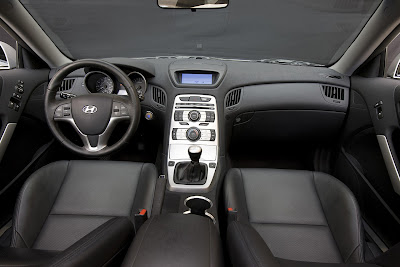
Interior Photo : Inside View of 2010 Hyundai Genesis RWD Sports Coupe ---------------- ----------------
Official Press Release
PRESS RELEASE:
ALL-NEW HYUNDAI GENESIS COUPE: A NEW BENCHMARK FOR AFFORDABLE 300-HORSEPOWER SPORTS COUPES
NEW YORK, March 19, 2008 – Hyundai unveiled Genesis Coupe, a new benchmark for affordable 300-horsepower sports coupes, during a press conference at the New York International Auto Show today. The 2010 Genesis Coupe is a purpose-built rear-wheel drive sports coupe featuring two performance-focused engines – a 212-horsepower 2.0-liter turbocharged four-cylinder engine and a range-topping all-aluminum 306-horsepower, DOHC 3.8-liter V6 engine. Genesis Coupe is scheduled to join the Hyundai lineup in the spring of 2009.
Following the introduction earlier this year of the rear-wheel drive Genesis sports sedan, Genesis Coupe is Hyundai's most dynamic performance car ever and the second consecutive all-new model introduction from Hyundai appealing directly to the car enthusiast. Genesis Coupe uses the same flexible rear-wheel drive architecture that was originally developed for the Genesis sports sedan.
Genesis Coupe employs a MacPherson strut dual-link front suspension and a five-link rear suspension setup. Both engines are mated to a standard six-speed manual transmission. The Genesis Coupe 2.0t (2.0-liter 4-cylinder turbo) offers an optional five-speed automatic with SHIFTRONIC® while the 3.8-liter V6 offers a ZF six-speed automatic transmission with SHIFTRONIC to handle the additional torque.
"We think our entry-level Genesis Coupe 2.0t, with its unique combination of rear-wheel drive and four-cylinder turbo power, offers an intriguing alternative to existing front-wheel drive sports coupes," said John Krafcik, vice president, product development and strategic planning, Hyundai Motor America. "The 3.8-liter version of Genesis Coupe takes things to an even higher level, rivaling the capability of premium-performance coupes like Infiniti G37."
Genesis Coupe was shown as a concept at the 2007 Los Angeles Auto Show and its transformation from concept to production reveals that its signature design features have emerged intact. Genesis Coupe is also unmistakably linked to several Hyundai concept cars. The powerful curves, surface detail, and "Z" bodyside lines come straight from the HCD9 Talus and the HCD8 sports coupe. Genesis Coupe's arching roofline and tapering greenhouse highlight the exterior profile and emphasize the car's broad shoulders and wide stance. Genesis Coupe rides on standard 18-inch alloy wheels or optional 19-inch wheels, both delivering a bold stance and aggressive handling.
In keeping with its mission to be the most exciting, affordable sports coupe on the road, the Genesis Coupe boasts a cockpit designed to enhance the driving experience. An information display screen, features an outside temperature reading, audio system information and HVAC settings. Analog gauges include a large speedometer and tachometer positioned so the driver can immediately access critical driving information. The instrument cluster features Hyundai's signature blue gauge illumination.
Music lovers will welcome the inclusion of standard auxiliary input jacks (3.5 mm mini-jack and USB input) to accommodate and charge audio devices such as iPods®. Among the other refinements are an Infinity audio system, sport bucket seats and two-stage front seat warmers. Genesis Coupe also offers the convenience of a proximity key and push button starter.
The 2010 Genesis Coupe includes a wide range of both active and passive safety features. Standard safety equipment includes driver and front passenger advanced frontal airbags, along with front seat-mounted side airbags, side air curtains, active front head restraints, four-channel ABS with Electronic Brake-force Distribution (EBD), and Electronic Stability Control (ESC), one of the industry's most effective life-saving technologies.
GENESIS COUPE SPECIFICATIONS Configuration: Front engine, rear-wheel drive Wheelbase: 2820 mm / 111.0 inches Overall length: 4630 mm / 182.3 inches Overall width: 1865 mm / 73.4 inches Overall height: 1380 mm / 54.3 inches Wheels: 18-inch or 19-inch five-spoke Engine types: 3.8-liter V6 or 2.0-liter 4-cylinder turbo Est. horsepower V6: 306 @ 6,000 rpm (regular fuel) Est. horsepower V6: 310 @ 6,000 rpm (premium fuel) Est. torque V6: 263 lb. ft. @ 4,700 rpm (regular and premium fuel) Est. horsepower 2.0t: 212 @ 6,000 rpm (regular fuel) Est. horsepower 2.0t: 223 @ 6,000 rpm (premium fuel) Est. torque 2.0t: 217 lb. ft. @ 2,500 rpm (regular and premium fuel) Block & head materials: aluminum for both engines Valvetrain: DOHC for both engines Valve timing: continuously variable valve timing for both engines (Dual for 2.0t) Estimated 0-60 mph V6: under 6 seconds Transmission types: 6-speed manual, 5-speed automatic (4-cylinder) or 6-speed manual, 6-speed automatic (V6) Front brakes: 12.6-inch (standard) 13.4-inch (Brembo package) Rear brakes: 12.4-inch (standard) 13.0-inch (Brembo package) Front calipers: single piston floating (standard), monobloc four-piston (Brembo package) Rear calipers: single piston floating (standard) monobloc four-piston (Brembo package) Limited slip differential (Optional) Est. top speed: 149 mph (V6), 137 mph (2.0t) Base curb weight: 3549 lbs. (V6); 3439 lbs. (4-cylinder)
---------------- ----------------
Photo : 2010 Hyundai Genesis RWD Sports Coupe at 2008 New York International Auto (Motor) Show Read more >>
This auto review page contains features and specifications(specs) of 2009 Honda Fit/Jazz along with its video review and hi-res photos.
USA spec 2009 Honda Fit/Jazz Specifications, Features & Equipment Debut(unveiled) at: 2008 New York Auto(Motor) Show on 03/19/2008 Available(launch): In USA showrooms by fall of 2008 Key Features:Honda's voice-recognizing satellite-linked navigation system featuring a 6.5-inch screen, rear Magic Seats, USB port for MP3 players and iPod. Safety Equipment: Vehicle Stability Assist (VSA), active head restraints, Dual-stage, dual-threshold front airbags, dual front-side airbags with passenger-side Occupant Position Detection System (OPDS), side-curtain airbags, anti-lock braking system (ABS), with ventilated discs in the front and drums in the back, and electronic brake distribution (EBD). Engine: 1.5-literi-VTEC™ 4-cylinder engine Transmission: 5-speed manual transmission or an available 5-speed automatic transmission Tires: 15-inch and 16-inch (Fit Sport) wheels Seats: 2+3
---------------- ----------------
Fit Video : 2008 New York International Auto Show: 2009 Honda Fit Introduction Dick Colliver introduces the 2009 Honda Fit to the media at the 2008 New York International Auto Show on March 20, 2008
---------------- ----------------
New York 2008: 2009 Honda Fit gets in shape The 2009 Honda Fit has landed, and done so with everything the previous Honda fit was lacking. Judging by the sales numbers of that previous Fit -- over 2,000,000 globally in six years -- it wasn't lacking too much. The car gets Honda's voice-recognizing satellite-linked navi; 3-mode, single-motion dive-down Magic Seats in back (parents, it's not what you think); a revised suspension and more rigidity. And with the addition of a USB port for MP3 players and another storage bin -- because there simply wasn't room for all your stuff before -- the new Fit comes with even more fun. source:Autoblog
---------------- ----------------
Photo: 08-09 Honda Fit/Jazz For US at 2008 New York Auto Show ---------------- ----------------
2008 New York Auto Show Preview: 2009 Honda Fit American Honda Executive Vice President Dick Colliver said the new Fit "will reconfirm that small can in fact be big." The new Fit made its global debut at the 2007 Tokyo Auto Show last fall. It has improved interior space over the model currently on sale here — especially for rear-seat passengers — with its windshield moved forward nearly 5 inches and its wheelbase extended to 98.4 inches. The new model is also slightly wider. source:Edmunds
---------------- ----------------
Photo: Front-Side View of 08-09 Honda Fit/Jazz For US(America), ---------------- ----------------
Photo: Back View of 08-09 Honda Fit/Jazz For US(America), ---------------- ----------------
2009 Honda Fit Makes US Debut at New York Show Set to go on sale in the US this fall, the new Honda Fit -also known as the Jazz in Europe and other markets, made its North American debut today at the New York Auto Show. The new Fit is slightly bigger than the current model with the overall length increased by 2.2-inches, the width by 0.8-inches and the wheelbase by 2.0-inches. source:Carscoop
---------------- ----------------
Photo: Magic Seats of 08-09 Honda Fit/Jazz For US(America)
---------------- ----------------
2009 Honda Fit Is Go, Again ...notable features are the 1.5-liter i-VTEC engine mated to either a 5-speed manual or automatic transmission - the Fit Sport comes with paddle shifter - the six airbags that come as standard, the ACE body structure - it's strong and light to boost safety - and the one-touch fold rear seats. source:Jalopnik
---------------- ----------------
Photo: Back Seats Folded Down of 08-09 Honda Fit/Jazz For US(America) ---------------- ----------------
Up Close: 2009 Honda Fit In person, the new Fit looks a lot like the old Fit, but with a longer and more gradually sloping nose. The base of the A-pillars are farther out in front, which puts them more in your line of sight. They're not too thick, though, and Honda put small sail-shaped windows between them and the front of the door. It looks a bit peculiar from the outside, with the windows extending even farther past the front doors, but it helps with visibility.
The 60/40-split backrests fold forward in a single step. You can also raise the seat cushion, giving a super-tall space between the floor and ceiling, similar to the backseats of some pickup trucks. There's even a storage box inside one of the seat cushions that’s accessible from its underside. source:Kicking Tires
---------------- ----------------
Photo: Magic Seats of 08-09 Honda Fit/Jazz For US(America)
---------------- ----------------
Honda Shows Off New Version of Fit Honda Unveils 2009 Fit, Saying It Combines Style and Fuel Efficiency Officials for American Honda Motor Co. on Wednesday unveiled the automaker's new version of the Honda Fit, saying it improves upon what customers liked most about previous versions. Dick Colliver, executive vice president of American Honda, said the 2009 Fit takes small cars to a place where they are "more than just a cheap set of wheels."
"Customers like that the Fit is an entry level car that doesn't feel like an entry level car," Colliver said. "Buying a Fit is a choice, not a compromise." source:CNN
---------------- ----------------
Photo: Interior View (dashboard, steering & front seats) of 08-09 Honda Fit/Jazz For US(America) ---------------- ----------------
2009 Honda Fit makes debut at New York Auto Show Honda, leading the pack in nearly every quality and value survey, knows how to make tiny ... cool. Notable improvements in the new Fit include: rear Magic Seat featuring one-motion dive-down functionality, which allows the rear seat to fold flat with the front seats in the rearmost slide position, without removing the rear head restraints; a new hidden storage bin under the driver's side rear seat; an available Honda Satellite-Linked Navigation System with Voice Recognition and 6.5-inch screen. source:Consumer Passion
---------------- ----------------
Photo: Interior View (steering, controls, navigation system, power outlet) of 08-09 Honda Fit/Jazz For US(America) ---------------- ----------------
What’s New about 2008 - 2009 Honda Fit? *Introduction of a Road Sailing (RS) version in the Fit lineup Overall length, width and wheelbase have been increased. *Tire Pressure Monitoring System is provided. *An emergency tire repair kit is provided instead of a spare tire. *The front quarter windows are three times of the size of those in the previous model, and the width of the front pillar has been reduced by 20 mm to provide enhanced visibility. *The rear seats are 20 mm wider, 15 mm deeper, and have cushions 10 mm thicker for enhanced ride comfort in comparison to previous model. Full Review can be read here. source:Reviews
---------------- ----------------
Photo: Front View of 08-09 Honda Fit/Jazz For US(America) ---------------- ----------------
Official Press Release
PRESS RELEASE
NEW YORK: The all-new 2009 Honda Fit, set to go on sale in the U.S. this fall, is making its U.S. debut at the New York International Auto Show, American Honda Motor Co., Inc., announced today. The Fit promises to further its leadership in the subcompact segment with top-of-class feature content, including an available Honda Satellite-Linked Navigation System™; improved interior functionality, including one-motion dive-down rear seats; enhanced sporty demeanor through improved suspension, steering and body rigidity; and high levels of standard safety equipment, including Honda's Advanced Compatibility Engineering™ (ACE™) body structure.
"Critics and customers alike have voted the Fit among the best small vehicles on the road," said Dick Colliver, executive vice president of American Honda. "This new Fit raises the bar even further, taking what was already great about the Fit, making it even better and throwing in a healthy dose of refinement."
Enhanced Comfort and Convenience
Dimensionally compact on the outside, the interior provides surprisingly large passenger and class-leading cargo space to maximize comfort and utility. At the foundation is an improved rear Magic Seat®, now featuring one-motion dive-down functionality, which allows the rear seat to fold flat with the front seats in the rearmost slide position and without removing the rear head restraints. The seats offer multiple seating and cargo-carrying configurations (tall object mode, long object mode and utility mode) in addition to the standard five-passenger mode. Additionally, a new hidden storage bin under the driver's side rear seat provides a place to store small items.
Adding further refinement, Fit Sport offers an available factory-installed Honda Satellite-Linked Navigation System™ with Voice Recognition, featuring a 6.5-inch screen. All Fit Sport models feature a USB audio interface1 compatible with current generation iPods® and many USB storage devices.
"The goal is to provide entry-level vehicle customers with functionality and refinement that's a class above," said Colliver. "Buying a Fit is a choice, not a compromise."
Fun to Drive
The Fit features a new 1.5-literi-VTEC™ 4-cylinder engine connected to either a 5-speed manual transmission or an available 5-speed automatic transmission, which includes steering-wheel-mounted paddle shifters on the Fit Sport. The new engine is designed to offer the best balance of fuel economy and power. Larger 15-inch and 16-inch (Fit Sport) wheels hint at enhancements to the Fit's suspension, steering and body rigidity, which are intended to produce sportier handling without sacrificing comfort.
Video Review: 2009 Honda Fit/Jazz for United States being unveiled at 2008 New York Auto(Motor) Show
Top-of-Class Standard Safety Equipment
The 2009 Fit adds Honda's Advanced Compatibility Engineering (ACE) body structure technology, available Vehicle Stability Assist ™ (VSA®) and active head restraints, to a top-of-class list of standard safety features. With Fit's adoption of ACE, more than 94 percent of Honda vehicles sold in the U.S. will include the innovative body structure. When introduced to the 2009 Fit, VSA will be available in the lineup of every model Honda sells in the United States. Dual-stage, dual-threshold front airbags, dual front-side airbags with passenger-side Occupant Position Detection System (OPDS) and side-curtain airbags are standard equipment on all Fit models. All seating positions have three-point seat belts. Additionally, front and rear visibility is improved.
Standard active safety equipment includes an anti-lock braking system (ABS), with ventilated discs in the front and drums in the back, and electronic brake distribution (EBD).
More detailed information about the 2009 Honda Fit will be released closer to the vehicle launch in the fall.
Additional media information and high-resolution photography is available at www.hondanews.com.
1USB audio interface is used for direct connection to, and control of a variety of digital audio players such as iPods(1) and other USB devices(2) that contain MP3, WMA, or AAC music files(3). (1) Fifth generation or later iPod, nano, iPod Classic, iTouch, or iPhone. (2) Some USB devices such as those with security software may not work. (3) Except for Digital Rights-protected files.
Read more >>
2009 Lamborghini Gallardo LP560-4 was revealed on 03-04-2008 at 2008 Geneva Motor Show
Quick Statistics & Specs Top Speed: 202 mph (325 km/h) Acceleration: 0 to 62 mph (100 km/h) in 3.7 seconds Drivetrain: 560-hp, 5.2-liter V-10 with six-speed manual or six-speed sequential with paddle shifter Hits dealerships: Late spring 2008 Competes with: Porsche 911 Turbo, Ferrari F430, Audi R8 Price: Start at around US$222,000
---------------- ----------------
Introduction Automobili Lamborghini S.p.A., commonly referred to as Lamborghini, is an Italian manufacturer of high performance sports cars based in the small Italian village of Sant'Agata Bolognese, near Bologna. Lamborghini is now a subsidiary of German car manufacturer Audi AG, which is in turn a subsidiary of Volkswagen Group.
The Lamborghini Gallardo is a sports car built by Lamborghini. The Gallardo is Lamborghini's most-produced model to date, with 5,000 built in the first three years of production. It is less expensive than Lamborghini's larger, more powerful Murciélago. The car is named after a famous breed of fighting bull. The Spanish word gallardo translates into "gallant". Official Website: Lamborghini.com
2008 Geneva Auto Show: Lamborghini Gallardo LP560-4 The front end of the Gallardo has been resculpted, with larger air intakes providing additional cooling. Headlights combine bi-xenon lamps and LED running lights. The rear end also has been redesigned, drawing on styling cues from earlier Lamborghinis, including the fabled Miura. Customers can select from leather or Alcantara upholstery and trim, with carbon-fiber accents also available. Standard equipment includes air-conditioning and a multimedia system. source: Edmunds
2009 Lamborghini Gallardo LP560-4: Facelift Model with 560Hp Debuts in Geneva "The new Gallardo LP560-4 is a significantly enhanced version of what was already an extreme car," said Stephan Winkelmann, President and CEO of Lamborghini. "With an even more sharply defined character, the new Gallardo LP560-4 is also innately elegant and sensuous: the expression of an uncompromising lifestyle." source: CarScoop
---------------- ----------------
Geneva 2008: Lamborghini Gallardo LP560-4 live and drool-worthy As its name implies, the gussied-up Gallardo is sporting 560 hp from its new, direct-injected 5.2-liter V10. Hacking off 20 kilos from the curb weight allows the LP560-4 to rocket to 62 mph in 3.7 seconds and on to a top speed of 201 mph, all the while increasing fuel efficiency and reducing CO2 emissions by some 18-percent. source: Autoblog
---------------- ----------------
2008 Geneva Motor Show: 2009 Lamborghini Gallardo LP560-4 Lamborghini is showing a new LP560-4 Gallardo at the 2008 Geneva auto show. The Gallardo is the smaller supercar of Lamborghini’s two current offerings, and the latest LP560-4 has a 5.2-liter V-10 making 560 hp — up from the current Gallardo’s 520 hp. This peak power gives the LP560-4 its name, while the “4,” refers to the LP560-4’s four-wheel drive, which splits power 30% to the front wheels and 70% to the rear. Transmission options include either a six-speed manual or six-speed sequential with paddle shifters. source: Kicking Tyres
Official Press Release : 2009 Lamborghini Gallardo LP560-4
PRESS RELEASE
Sant'Agata Bolognese, March 3rd, 2008 Lamborghini Gallardo LP560-4
Setting a New Standard
Powerful elegance - a new definition
With the new Gallardo LP560-4, Lamborghini once again sets a higher standard for super sports cars. With its new engine, permanent four-wheel drive transmission and new suspension, it delivers clearly improved performance and dynamics. In parallel, its innovative design takes the classic lines unique to the Lamborghini brand one step further. Powerful elegance has never been so defined before.
The Gallardo LP560-4 is the successor of the most successful Lamborghini model of all time. Approximately 7100 Gallardo models have left the Sant'Agata Bolognese production plant since its launch in 2003. "The LP560-4 will consolidate this success story," states Stephan Winkelmann, President and CEO of Automobili Lamborghini. "It will outclass its predecessor in every aspect; its dynamics are distinctly breathtaking and its design sets new standards. With the introduction of the Gallardo LP560-4, we will consistently continue Lamborghini's growth strategy".
The powerful heart of the Gallardo LP560-4 is the new 5.2 litre V10 engine with an output of 560 PS (412 kW) at 8000 rpm. The increase of 40 PS compared with that of the previous Gallardo, and the approximate 20 kilogram reduction in weight, improves the power weight ratio to 2.5 kilograms per PS (hp) and thus enhances performance. The LP560-4 accelerates from 0-100 km/h in 3.7 seconds, its speed at 11.8 seconds is 200 km/h and its top speed lies at 325 km/h. At the same time the new, highly efficient engine enthrals its driver with its direct fuel injection system - "Iniezione Diretta Stratificata". Despite its clearly increased power, fuel consumption and CO 2 emissions have been reduced by a staggering 18 percent.
The engineers in the Sant'Agata-based Technical Department have also improved traction, handling and stability at high speeds. The redesigned four-wheel drive transmission, the new suspension and the optimised aerodynamics as well as the reduced weight and decreased friction between the components, all contribute to the overall improvements in the vehicle. Thus the Gallardo LP560-4 presents itself as a cutting edge super sports car also suitable for the race-track. The car is also surprisingly suited to long-distance driving and despite its extreme performance capabilities is easy to control whilst maintaining utmost stability.
The Style Powerful elegance
A Lamborghini is and always will be a highly efficient athlete. Its extreme sensuality is based upon precision, performance and on spontaneous action. A Lamborghini's elegance is that of stark, purist strength. This DNA of the Lamborghini brand is being continuously developed by the Centro Stile in every new car. Thus the Gallardo LP560-4 displays the precise lines and clean surface edges in its distinctly minimalist design. Ornaments or embellishments of any form are alien to it.
Evolution of form systematically follows the demands of function: the newly designed front of the LP 560-4 squats deeply to the ground which contributes to its aerodynamic efficiency. The enlarged and clearly accentuated cooling intakes meet the demands of augmented engine power thus increasing the air circulation vital to a vehicle as powerful as this. The spoiler, positioned low between the air intakes, improves aerodynamic equilibrium at high speeds.
Characteristic LED – Daytime running light
The new headlights have a characteristic 'daytime' running light integrated beneath the Bi-Xenon lamps: 15 diodes (LED) have been positioned in a Y structure. The same motif appears again in the rear tail-lights. The stop and brake lights have been inspired by the Miura Concept, the Murciélago LP640 and the Reventón and display the Y form three times over.
The completely redesigned rear gives the definition "powerful elegance" a new meaning: rear lights, air cooling vents, bumper and diffuser are arranged in precise positions on the car's exterior, which make the LP560-4 appear extremely wide and bonded to the road surface. In addition, the streamlined covers left and right of the engine hood accentuate the powerful shoulders and lengthened, stretched lines of the new Gallardo.
Clearly improved aerodynamics
The rear diffuser has been newly designed, is more efficient with respect to its predecessor and, together with the smooth underbody, contributes to the excellent steering stability even at extremely high speeds. In sum, the aerodynamic efficiency with regard to output compared to that of its predecessor has been increased by 31 %. The Gallardo LP560-4 takes fast curves even more supremely.
The designers in Sant'Agata Bolognese have excelled themselves with the clear-cut, pure, stark lines of the Gallardo LP 560-4. They also have demonstrated distinct attention to detail; the elaborate aluminium cap for petrol and motor oil are testimony to this, as is the rear camera which has been integrated in a small fin in the independent rear spoiler as well as the finely-crafted grille in the exhaust pipes.
The body
Weight is undesirable in a sports car and a lightweight model encourages the dynamics of such a vehicle. Aluminium is much lighter than sheet steel and this is why the Gallardo LP560-4 is produced with a body in a much lighter but nevertheless more stiff structure: the two-seater car measures 4.34 metres in length, 1.90 metres in width and a mere 1.16 metres in height. It weighs in dry at 1410 kilograms - which is, effectively, 20 kilograms less that that of the previous Gallardo.
The construction of the Gallardo LP560-4 utilises what is known as a 'spaceframe construction method'. Integrally moulded node elements and extruded parts create its frame, and sheet metal plates made out of aluminium have been neatly and securely integrated to form the body. The body is not only extremely light but also torsionally stiff and displays the highest safety characteristics. Thus the basis for the extraordinary handling characteristics of the LP560-4 is formed.
Integrated Pedestrian Protection system
The body of the car also demonstrates extremely high levels of 'passive security'. The Gallardo LP560-4 fulfils the not yet obligatory European directives regarding the protection of pedestrians. Furthermore, the geometry of the entire front of the car has been optimised with the addition of a special combination of materials behind the front bumper which serve to absorb any impact energy.
The Interior Luxurious individuality
Despite its low exterior height, the Gallardo LP560-4 welcomes its passengers with a spacious interior. The sports seats are covered with either fine leather or Alcantara® (upon request) and provide secure adherence and support. The position of the seats is very low, typical for sportscars. There is space behind the seats for luggage which complements the 110 litre front trunk.
The wide middle console is one of the elements which characterizes the impression of sporty dynamism in the interior. It accommodates the standard Lamborghini multimedia system as well as the air conditioning which can be regulated on both the driver's and passenger's sides. Between both of these elements lies a newly designed module consisting of classically elegant flip switches. Seven round instruments in the cockpit with a new graphic provide the driver with essential engine data and a multifunctional display between the speedometer and revolution counter provides the driver with important information.
Workmanship of the highest quality
The Miura and the other models of the 60s were already characterized by the excellent quality of workmanship which lay far and above the general standards of that time. Lamborghini has continued this tradition and even today delivers automobiles of the highest standards. The Gallardo LP560-4 indulges with the highest quality, aesthetically pleasing materials. With regard to the leather interior, an array of different colours and stitching (also in contrasting colours) are available. As an optional, Lamborghini can deliver the Gallardo LP560-4 with a further choice of leather and Alcantara® interiors as well as Carbon Fibre Packages. Here, elements such as the air-conditioning surrounds, the control panel, the handbrake handle and the gear-stick surrounds are available in carbon fibre.
Furthermore, the individualisation program, Ad Personam, enables the customer to create any combination of colour and trim, thus creating a highly personalised vehicle. After all, the new Lamborghini should perfectly reflect the owner's lifestyle.
The Engine Extreme power in every situation
The engine of the Gallardo LP560-4 is a completely new development. All that remains of the original V10 is the number of cylinders which, in this performance category, create a perfect and unique synthesis of torque, force of movement, sporty nimbleness, compact size and low weight.
The engine has a 5204 cm 3 volumetric displacement which, with 8.000 rpm creates the extreme 560 PS (412 kW). This results in the excellent performance per litre of 107.6 PS/lt. At maximum torque output, the engine yields 540 Newtonmeter at 6.500 rpm. The ample torque curve guarantees outstanding thrust from every engine speed. With an acceleration of 3.7 seconds from 0-100 km/h and a maximum speed of 325 km/h, the Gallardo LP560-4 shoots into the orbit of the most extreme and powerful sports cars.
Despite the clearly improved driving performance of this super sports car, Sant'Agata's engineers were nevertheless able to achieve a reduction in fuel consumption and CO 2emissions by 18 per cent. Measured by engine power and performance, the Gallardo LP560-4 e-gear's average fuel consumption of 13.7 litres per 100 kilometers, is extremely low.
The engine in this new model lies lengthways in front of the rear axle – hence the model description Longitudinale Posteriore. The concept of the mid - rear engine is unbeatable in sports car production, with the centre of gravity being displaced next to the vertical axis, thus creating the car's exceptional dynamics. Furthermore, it creates the basis for the Gallardo LP560-4's perfect weight distribution with 43 per cent on the front axle and 57 per cent on the rear. In combination with the permanent four-wheel drive transmission, superior driving stability and road adherence are guaranteed in all situations.
Reduced weight for inspirational torque
The crank case of the new ten cylinder of Lamborghini Gallardo is produced with an aluminium alloy. Separate cylinder liners are not necessary with this technology: instead, the liners, due to their exposure to the hard silicone crystals during the production phase, are bored directly out of the material. The connecting rods are made out of wrought steel and the pistons are produced from an aluminium alloy. The consequent reduction in weight, inertia and in friction losses contributes to the car's inspirational torque.
The engine is unusually wide for a V10, with a cylinder angle of 90 degrees. A definite advantage of this construction is the low centre of gravity. The reduction of the gravity centre height comes also from the dry sump layout of the lubrication system which also guarantees the reliability of the oil supply even during lateral acceleration and on the race-track.
Direct fuel injection improves efficient combustion
The new V10 uses the direct fuel-injection system "Iniezione Diretta Stratificata" as an innovative way to optimize performance results in part-load conditions. Here, the fuel is injected directly into the combustion chamber through the laterally positioned injector. Combined with the use of a 'tumble flap' in the intake manifold runners, this solution guarantees an optimized distribution of the gasoline in the combustion chamber (higher gasoline density around the spark plug, leaner mixture close to piston and cylinder liners) and delivers the basis for a highly efficient combustion system even with stoichiometric mean mixture composition. The direct injection boosts the extremely efficient 'full load' performance of the V10, reduces its knock sensitivity and thus enables the very high compression ratio of 12.5:1. The cylinder heads have been optimised to deliver a very quick gas exchange and the variable valve control system on all four camshafts improves the charge efficiency across the entire engine speed range.
Transmission Superior control four-wheel drive
Such extreme power must be brought onto the streets with extreme reliability. The driver of a Gallardo LP560-4 can thus rely on the four-wheel drive Viscous Traction (VT) system, with the '4' in the model name a reminder of this. Lamborghini already introduced this system with the Diablo VT in 1993 – and for good reason: four actuated wheels achieve more grip than two and permit acceleration earlier in the curve exit.
The protagonist in the transmission is the central viscous-coupling which requires no electronic control. In this special Lamborghini configuration, the driving torque is distributed between front and rear – generally with a 30:70 front to rear ratio and, within milliseconds, adapts to even the slightest variations in road conditions. A mechanical differential on the rear axle provides up to 45% limited slip and an electronic differential lock at the front complete the four-wheel drive system.
Superior traction and handling
Not only does the maximum traction take advantage of the permanent four-wheel drive system, but also the car's clearly superior handling. Each wheel can only transfer a certain amount of torque to the road. As the propulsion power is distributed onto all four wheels through the viscous traction system, more potential for directional control remains - and reserves in every situation distinguish a perfectly made sports car.
Despite all the engine thrust, changing gears in the Gallardo LP560-4 is one of the most exciting experiences of driving this vehicle. It is still the customer's personal preference as to whether he wishes to change gears manually through the exact 'gate' guides of the six-speed gearbox via the short gear stick, or whether he prefers to let his fingertips control the e.gear's paddle-shift system located behind the steering wheel: the latter solution becoming the preference of the majority of Lamborghini customers.
Gear change time reduced by 40 per cent
The automated e-gear transmission has been completely redesigned and improved in all aspects. The complete system has not only been reduced in weight, but the time employed to change gears has also been reduced by 40 per cent in "CORSA" mode. The driver may choose between five different driving and changing programs: in addition to the 'normal' mode, the Gallardo LP560-4 offers a SPORT programm with its even more rapid gear changing times and increased number of revolutions. The CORSA program directs the engine to optimum acceleration. It permits a greater slip angle and also allows - with maximum safety - the full dynamism of the LP560-4 to be enjoyed even on a race-track. The 'Thrust Mode' ensures maximum acceleration from neutral while the angle of the throttle valve and the clutch are here optimally adjusted to one another. Finally the Automatic mode: here the engine changes gear in total independence and permits a particularly comfortable mode of driving.
The Suspension High-tech parts with Lamborghini know-how
Even the Gallardo LP560-4's predecessor was one of the world's best super sports cars with regard to handling, precision and driving stability. However, the latest model provides an even more intense driving experience: the new suspension improves the car's handling, its driving comfort and its directional stability at high speeds.
The Gallardo LP560-4's space frame is uncompromisingly high tech. Its technical production was conceived from motor sport technologies. The double wishbones made out of aluminium with newly designed kinematics, while the springs and shock absorbers are tightly adjusted for grip.
The rear axle now has an additional track rod which further improves the excellent control of this super sports vehicle. Newly developed elements are the rubber-metal bearings - authentic high-tech parts - which clearly improve the special Lamborghini driving dynamics with well-chosen material combinations and cleverly defined assembly.
Extreme road adherence
The steering rack works with relatively little assisted steering support, thus bonding the driver closely to the road. This in turn provides him with an intense experience of power and impulse. The steering has its own cooling system for the power steering fluid.
Precise, breathtakingly fast, whilst stable and free from surprises, the Gallardo LP560-4's dynamics assures a sensuous experience. The LP560-4's tyres (format 235/35 ZR 19 front and 295/30 ZR 19 rear) appear to bond with the asphalt. Specially developed Pirelli P-Zero series tyres are fitted: these have a particularly low roll resistance which also maintains tyre wear at a minimum without, of course, any reduction in their performance quality. At a speed of over 120 km/h an independently extended rear spoiler increases the downforce on the rear axle It acts in association with the specially formed underbody which directs the airstream under the car.
Optional Carbon Ceramic Brake system
The new braking system acts with brute force. At the front, eight 'Brembo specialist' cylinder callipers grasp the 365 mm diameter brake discs. At the rear, four cylinder callipers act on the 356 mm brake discs. In addition, the new disc ventilation system improves the stability in extreme situations. Optionally, discs made out of Carbon Ceramic are offered. At the front the CCB (Carbon Ceramic Brakes) discs measure 380mm in diameter and at the rear 356mm. They deliver much improved performance at a reduced weight. In total, the CCB braking system is lighter in weight that, at the wheel, improves driving dynamics and comfort.
The interior and trim
With the Gallardo LP560-4 Lamborghini provides its customers with a generous and sporty standard equipment package. Direct from the production line, a customer will find included in his vehicle passenger and lateral air-bags; a two-zone air-conditioning system with sun regulation; The Lamborghini Multimedia System including an USB connector; and sports seats with an electronically operated backrest. In addition to this, the interior trim includes fine leather and Bi-Xenon headlights with LED daytime running light. The car is supplied with new Apollo wheels as standard.
A large variety of options increases the interior comfort of the vehicle, including a navigation system and a module for TV reception, a hands-free Bluetooth® phone set, an anti-theft device and a rearview camera. A further option is the lifting system control of the front of the vehicle which, at the touch of a button, is raised to enable driving over obstacles. The new polished cross wheel rims 'Cordelia' or the black Y-rims 'Callisto' complete the options range. Finally, the engine hood made from glass creates a showcase for the heart of the Gallardo LP560-4.
The possibilities and different combinations available in the Individualisation Program Ad Personam are almost inexhaustible. Behind this program stands the philosophy that a super sports car of this nature should, after all, reflect the personality of its owner by enabling him to completely indulge his expectations and wishes. As a consequence, extreme exclusivity is the trademark of Lamborghini's individualisation program. "Think the Impossible" states the motto. Ad Personam offers a host of options in order that a customer may give the car an imprint of his own style with respect to the interior trim and exterior. A new highlight in the program are the following three exclusive matt colours: Nero Nemesis (matt black), Bianco Canopus (matt white), Marrone Apus (matt brown). The new matt colours underline the clearly defined and purist precision of the Lamborghini design.
Technical data
Frame & Body
Frame Structural aluminium spaceframe, based on aluminium extruded parts welded to aluminium casted joint elements. Body Aluminium with thermoplastic "hang on" parts Rear Spoiler Electronically controlled Mirrors External mirror with ectrical closing system Suspension Double wishbones front and rear suspension system, antiroll bar anti-dive and anti-squat ESP 8.0 Full ESP System with ABS,ASR and ABD
Airbags
Front Front Dual Stage driver and passenger airbags, side Head-thorax airbags
Pneumatici
Tyres (Frontreari) Pirelli Pzero 235/35 ZR 19 – 295/30 ZR 19 Wheels (front-rear) Aluminium aloy, 8.5" x 019"- 11"x 019" Steering Power- assisted rack and pinion Kerb-to-kerb turning circle 11,50 m
Brakes
Steel brakes Power vacuum, aluminium alloy callipers : 8 cylinder front callipers and 4 cylinder rear callipers Ventilated discs (front-rear) ø 365 x 34mm front –ø 356 x 32 mm rear CCB brakes Power vacuum, aluminium alloy callipers :6 cylinder front callipers and 4 cylinder rear callipers Ventilated discs (front-rear) ø 380 x 38mm front –ø 356 x 32 mm rear
Motore
Type 10 cylindres V90°, DOHC 4 valves,common-pin crankshaft displacement 5204 cc Compression ratio 12,5 : 1 Maximum power 412 kW (560 ps) at 8000 rpm Maximum torque 540 Nm 6500 rpm Engine management system Bosch MED 9 Cooling system Engine and Gearbox radiator Cooling system oil Oil to Water cooler Cooling system water Two water radiators Emission control system Catalytic converters with lambda sensors Lubrication system Dry sump
Driventrain
Type of trasmission Permanent 4-wheel drive with viscous traction system Gearbox 6 Speed + reverse, A optional, robotized sequential e-gear system with actuation by paddles on the steering column Clutch Double plate ø 215 mm Rear Differential 45% limited slip Front Differential Slip limitation by ABD function
Performance
Top speed 325 km/h Acceleration (0-100 km/h) 3,7 sec. Acceleration (0-200 km/h) 11,8 sec.
Dimensions
Wheelbase 2560 mm Overall legth 4345 mm Overall width 1900 mm Overall height 1165 mm Track (front– rear) 1632 mm – 1597 mm Carb Weight 1500 Weight distribution (front-rear) Front 43% - rear 57%
The U.S. Environmental Protection Agency (EPA) and the U.S. Department of Energy (DOE) released the 2008 Fuel Economy Guide to help consumers make well-informed choices when purchasing new vehicles.
"Today's consumers expect the biggest bang for their buck. By fueling them with information on this year's fleet of vehicles, we are putting Americans in the driver's seat to save money at the pump and protect our environment," said EPA Administrator Stephen L. Johnson. "As we see in the wide range of fuel efficient leaders, 'going green' can fit the needs of any lifestyle."
"Greater fuel efficiency is something we must approach more aggressively, effectively and creatively than we have over the past 30 years," Secretary of Energy Samuel W. Bodman said. "The president's ambitious Twenty in Ten Plan forces us not only to approach increased vehicle efficiency like never before, but significantly reforming CAFE standards in a way where safety remains a priority."
Data show that hybrid vehicles continue to lead the government's fuel economy ratings and hybrid technology can be effectively used to improve fuel economy. The Toyota Prius tops the list at 48 mpg city and 45 mpg highway. More hybrid models are available than ever - including SUVs as well as cars - giving consumers greater choices when shopping for fuel efficient vehicles.
Fuel economy estimates, which appear on the window stickers of all new cars and light trucks prior to sale, are determined by tests that manufacturers and EPA conduct according to EPA specifications. This year's label values are based on new test methods EPA finalized in December 2006. The new methods are designed to better account for actual driving conditions that can lower fuel economy, such as higher speed driving, use of air conditioning and cold weather operation. Because of the new methods, fuel economy estimates for all vehicles will generally be lower than those of last year.
2008 Model Year Overall Fuel Economy Leaders Rank Manufacturer/Model City/Highway MPG
1. Toyota Prius (hybrid-electric) 48/45 2. Honda Civic Hybrid 40/45 3. Nissan Altima Hybrid 35/33 4. Ford Escape Hybrid FWD 34/30 MazdaTribute Hybrid 2WD " Mercury Mariner Hybrid FWD " 5. Toyota Camry Hybrid 33/34 6. Toyota Yaris (manual) 29/36 7. Toyota Yaris (automatic) 29/35 8. Ford Escape Hybrid 4WD 29/27 Mercury Mariner Hybrid 4WD " Mazda Tribute Hybrid 4WD " 9. Toyota Corolla (manual) 28/37 10. Honda Fit (manual) 28/34
Lowest Fuel Economy by Vehicle Class for 2008 Model Year Class Model City/Highway MPG
Two Seater Lamborghini Murcielago (manual) 8/13 Minicompact Car Aston Martin DB9 Coupe, Volante (manual) 10/16 Subcompact Car Bentley Continental GTC 10/17 Compact Car Bentley Azure 9/15 Midsize Car Ferrari 612 Scaglietti (auto) 9/16 Large Car Bentley Arnage RL 9/15 Small Station Wagon Audi S4 Avant (manual) 13/20 Midsize Station Wagon Mercedes-Benz E63 AMG Wagon 12/18 Sport Utility Vehicle* Mercedes-Benz G55 AMG 11/13 Minivan* Toyota Sienna 4WD 16/21 Pickup Truck* Rousch Performance Stage3 F150 11/15 Van (Passenger and Cargo)* Passenger Chevrolet G1500/2500 EXPRESS 2WD 12/16 " Chevrolet H1500 EXPRESS AWD " " GMC G1500/2500 SAVANA 2WD " " GMC H1500 SAVANA VAN AWD " Cargo Chevrolet G15/25 VAN CONV 2WD " " Chevrolet H1500 VAN CONV AWD " " GMC G15/25 SAVANA 2WD CONV " " GMC H1500 SAVANA AWD CONV "
*Trucks over 8500 pounds gross vehicle weight rating are currently exempt from federal fuel economy requirements
Highest Fuel Economy Models by Vehicle Class for 2008 Model Year Class Model City/Highway MPG
Two Seater Audi TT Roadster (2 liter engine,auto) 22/29 Minicompact Car Mini Cooper Convertible (manual) 23/32 Subcompact Car Toyota Yaris (manual) 29/36 Compact Car Honda Civic Hybrid 40/45 Midsize Car Toyota Prius (hybrid) 48/45 Large Car Honda Accord 4Dr Sedan (manual) 22/31 Small Station Wagon Honda Fit (manual) 28/34 Midsize Station Wagon Passat Wagon (manual) 21/29 Sport Utility Vehicle Ford Escape Hybrid FWD 34/30 Mazda Tribute Hybrid 2WD " Mercury Mariner Hybrid FWD " Minivan Dodge Caravan 2WD 17/24 Chrysler Town & Country 2WD " Pickup Truck Ford Ranger Pickup 2WD (manual) 21/26 Mazda B2300 2WD (manual) " Van (Cargo&Passenger)Chevrolet G1500/2500 Van 2WD 15/20 (4.3 liter engine) GMC G1500/2500 Savana 2WD Cargo " (4.3 liter engine)
Lowest Overall Fuel Economy Models* for 2008 Model Year Rank Manufacturer/Model City/Highway MPG

 ----------------






.jpg)
.jpg)
.jpg)
.jpg)
.jpg)
.bmp)